Perimenopause & Menopause: Understanding Your Changing Hormones
If you've read some of my other posts, you've seen a theme emerging: your hormones, gut, and mood don't operate in isolation — they're constantly influencing each other. Nowhere is that more true than in perimenopause and menopause, when shifting hormones can touch nearly every system in your body at once. This post pulls that thread through, and gives you a practical guide to what's actually happening, how we investigate it, and what treatment — including bioidentical hormone therapy (BHT) — can look like.
What Menopause Actually Is
Menopause has a surprisingly precise definition: it's one single day. Specifically, it's marked retrospectively, once you've gone 12 consecutive months without a period. Everything leading up to that day — the months or years of shifting, unpredictable cycles and emerging symptoms — is perimenopause. Everything after it is postmenopause. So while people often use "menopause" to describe the whole transition, technically it's a single point in time, bookended by two much longer phases.
What Age Does This Happen?
There's no single rule here. Perimenopausal symptoms can start showing up as early as your mid-30s, well before periods become irregular, while natural menopause itself (that single day, 12 months after your last period) typically lands between 45 and 58, with the average in North America around 49-51. So the transition as a whole — symptom onset through to that final day — can realistically span anywhere from your mid-30s into your late 50s or beyond.
One of the more interesting patterns we see is that it tends to run in families. Multiple large studies — including the Framingham Heart Study and the UK Breakthrough Generations Study — have found that genetics account for roughly 40-65% of the variation in when a person reaches menopause. In practical terms: women whose mothers went through menopause earlier tend to go through it earlier themselves, and the same holds true for later menopause. In one study of mother-daughter pairs, daughters reached menopause about a year earlier than their mothers on average, and women were roughly six times more likely to experience early menopause (before 45) if their mother had. So if you want a rough sense of your own timeline, your mother's (and sometimes your grandmother's or older sisters') experience is genuinely informative — though far from the only factor, since diet, smoking, and other health conditions play a role too.
Recognizing the Signs: Why Symptoms Vary So Much
We're all familiar with hot flashes and night sweats, but menopause can genuinely touch nearly every system in the body, because estrogen and progesterone receptors exist throughout the body — not just in reproductive tissue. This is why the symptom list is so much longer than most people expect:
Brain: brain fog, word-finding trouble, memory changes, mood shifts, anxiety, irritability
Heart: heart palpitations, changes in blood pressure and cholesterol
Bone: accelerated bone loss, increased fracture risk
Skin and hair: dry skin, hair thinning or hair loss
Sleep: insomnia, disrupted sleep architecture
Thyroid: symptoms can overlap significantly with thyroid dysfunction, which is part of why we always check thyroid function alongside reproductive hormones
Estrogen decline specifically affects blood vessel flexibility and cholesterol metabolism, which is part of why cardiovascular risk changes after menopause, and it plays a documented role in brain structure, connectivity, and energy metabolism — which is exactly why brain fog and memory changes are real, measurable phenomena and not "just in your head."
Because the range of symptoms is so wide, and because everyone's hormonal picture is genuinely unique, most people experience a combination of symptoms rather than a single dominant one — which is exactly why testing matters so much: it gives us a better picture of what's actually driving your particular pattern, rather than treating symptoms generically.
Why (and When) We Test Hormones
We typically test hormones around day 19-21 of your cycle if you're still menstruating (assuming a roughly 28-day cycle) — this timing targets the mid-luteal phase, when progesterone should be at its peak.
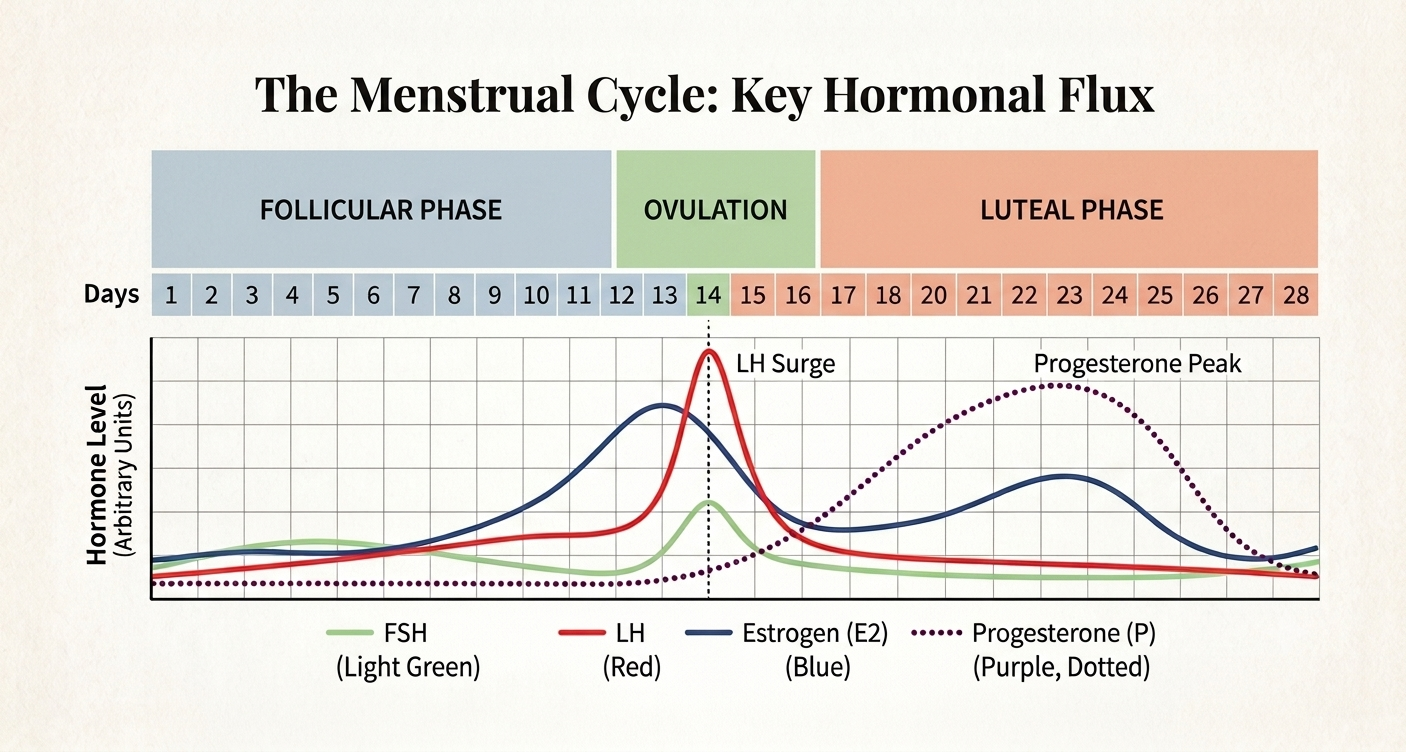
This visual shows the baseline rhythm of a standard 28-day cycle, tracking how Estrogen, Progesterone, LH, and FSH naturally peak and fall across each phase.
This timing matters clinically, not just practically. During the luteal phase, progesterone rises and its calming metabolite (allopregnanolone) affects GABA signalling in the brain — but as both hormones decline toward the end of the luteal phase, that's precisely when many people notice symptoms intensify: brain fog worsens, cramps and period pain increase, sleep becomes more disrupted, and mood symptoms peak. Testing during this window gives us a much more accurate read on how your hormones are actually behaving during the part of your cycle when you feel it most.
Testing Options
Standard bloodwork (through LifeLabs or Dynacare): typically includes estradiol, progesterone, testosterone, DHEA-S, and cortisol. Coverage for these markers varies by plan — it's best to check directly with your insurance provider.
DUTCH + OAT (Dried Urine Test for Comprehensive Hormones + Organic Acids Test): urine hormone metabolites have been validated against serum (blood) measurements in peer-reviewed research, showing strong correlation for reproductive hormones — though it's worth noting most of that validation research has involved the test's own manufacturer. What DUTCH+OAT adds beyond a standard panel is a full daily cortisol curve (rather than a single-point snapshot), insight into how your body is metabolizing its hormones, and additional markers like B6 status and melatonin. The kit ships directly to your home with a prepaid return label.
Salivary hormone testing: tests the same core hormones as bloodwork, plus a full cortisol curve, but reflects bioavailable (tissue-level) hormone levels rather than total bound hormone. Also ships directly to your home.
Other Markers We Look At
Because hormonal symptoms so often overlap with — or are worsened by — other health factors, I always look beyond reproductive hormones alone:
CBC (complete blood count) — screens for anemia and other underlying issues affecting energy
B12 — deficiency can mimic or worsen fatigue, brain fog, and mood symptoms
Ferritin — low iron stores are a common, often-missed contributor to fatigue
Thyroid panel (TSH and beyond) — thyroid dysfunction closely mimics menopausal symptoms and frequently coexists with it
Vitamin D — plays a role in bone health and immune regulation; deficiency is extremely common, especially through Manitoba winters
Metabolic panel — fasting insulin, HbA1c, cholesterol, and SHBG (sex hormone-binding globulin), since metabolic health and hormone levels influence each other significantly during this transition
A note on gut health: while there isn't always a specific gut test involved in this workup, gut health is never off the table when we're talking about hormones. As mentioned above with flaxseed and the estrobolome, a collection of your gut microbiome directly influences how estrogen is metabolized and recirculated in your body — so supporting gut health is consistently part of a comprehensive treatment plan, whether or not we run formal gut testing alongside it.
Regular Screening Still Matters
Perimenopause and menopause are also an important reminder to stay current on routine screening, since risk for several conditions shifts during this life stage:
Mammogram — generally recommended every 1-2 years starting around age 40-50, depending on your province's program and individual risk factors
Pap/HPV screening — generally every 3-5 years up to around age 65-70 for those with a history of normal results
Colorectal screening — starting around age 45-50, typically via stool-based testing, with colonoscopy for those at higher risk
DEXA (bone density) scan — generally recommended at menopause or by age 65, earlier with risk factors like family history of osteoporosis or long-term steroid use, since bone loss accelerates notably once estrogen declines
Thyroid function testing — worth including given the symptom overlap noted above
Cardiovascular risk assessment — blood pressure and cholesterol monitoring take on more importance post-menopause, given estrogen's protective role in vascular health prior to this transition
How We Treat: Guided by Your Results
Treatment is always based on what your testing and history actually show, not a one-size-fits-all protocol — but here's a sense of the kinds of tools we draw from and what they're actually addressing.
Sometimes we're treating based on symptoms directly. For vasomotor symptoms like hot flashes and night sweats, herbs like ashwagandha and black cohosh come up often. The evidence on black cohosh is mixed, which honestly reflects something true about most treatments: not everything works the same way for everyone. Some studies and reviews show a meaningful reduction in hot flash frequency, while others, including a 2016 JAMA meta-analysis, didn't find a significant benefit over placebo on average. That doesn't mean it won't work for you — it means it's a reasonable, low-risk option worth trying as part of your plan, and something we'll track to see how your body specifically responds. Ashwagandha has more limited but promising research specifically for menopausal symptoms, and its broader evidence for cortisol regulation is relevant here too, since cortisol and reproductive hormones are so tightly linked during this transition.
When the issue is more about how your body is clearing and metabolizing estrogen rather than how much you're producing, nutraceuticals like DIM (diindolylmethane) and I3C (indole-3-carbinol) come into play. These support the liver's detoxification pathways, helping shift estrogen metabolism toward its more favourable breakdown products rather than ones associated with estrogen dominance symptoms.
Cortisol support looks different depending on whether we're dealing with levels that are too high or too low. In both cases, we're often working with the same foundational building blocks — B vitamins and vitamin C, which your adrenal glands need to actually produce cortisol — alongside herbs like ashwagandha, which has research support for helping regulate cortisol in both directions depending on your body's needs.
For symptoms related to declining testosterone, like changes in energy, muscle mass, or libido, we look at both behavioural and nutraceutical support. Weight-bearing exercise has real, direct evidence for supporting healthy testosterone levels and maintaining muscle and bone mass through this transition, and herbs like maca are commonly used alongside it to support libido and overall vitality.
From a gut perspective, diet plays a genuine role in hormone health, not just general wellness. Flaxseed is a great example: it contains lignans that your gut bacteria convert into compounds called enterolactone and enterodiol, which have a mild estrogen-modulating effect by binding to estrogen receptors. This is part of a broader concept called the "estrobolome" — the collection of gut bacteria that influence how estrogen is metabolized and recirculated in the body. Research on flaxseed for menopausal symptoms is mixed but generally favourable, and it's a good example of why we never treat the gut as a separate system from your hormones.
And then there's supporting you as a whole person, beyond any single symptom. MCHC (microcrystalline hydroxyapatite) has some evidence, particularly alongside vitamin D, for helping slow bone mineral density loss during this life stage. Creatine has some genuinely exciting newer research: a 2025 randomized controlled trial in perimenopausal and menopausal women found that supplementation improved reaction time and increased brain creatine levels over eight weeks — a small first trial, so I'd call it promising rather than proven, but an encouraging and well-tolerated option. B vitamins and vitamin D support energy and overall function broadly, and checking iron levels ensures you actually have the resources your body needs to keep up with everything being asked of it during this transition.
We don't throw all of this at every person. This is exactly why the personal history, family history, and testing matter so much — they let us choose the combination that actually fits your specific pattern, rather than a generic list of "menopause supplements."
A Note on Bioidentical Hormone Therapy
For some people, especially with more significant symptoms, bioidentical hormone therapy is an option worth discussing — and one that carried a lot of unnecessary stigma for years. Several studies and reviews have found regulated, pharmaceutical-grade bioidentical formulations (patches, gels, vaginal creams, and micronized progesterone) more effective than placebo for vasomotor symptoms, with some research suggesting comparable effectiveness to older synthetic hormone therapies and a growing safety record when appropriately monitored — though, as with most areas of hormone research, results vary by formulation, dose, and individual.
It's a big enough topic — the different delivery routes, the distinction between regulated and compounded formulations, dosing philosophy, safety monitoring, and how prescribing works differently between Ontario and Manitoba — that I'm giving it its own dedicated post. For now, know that if hot flashes, sleep disruption, or other symptoms are significantly affecting your quality of life, this is absolutely worth a conversation, regardless of where you're located.
Ready to Make Sense of Your Symptoms?
Whether you're just starting to notice changes or you're deep in the thick of the transition, understanding what's actually happening — and having a real plan based on your own results — makes a genuine difference. I offer virtual naturopathic care across Ontario and Manitoba, including Brandon and the Westman region.
This post is educational and general in nature. It isn't a substitute for individualized medical care — please work with your care team, including a prescribing provider where hormone therapy is being considered.
References
Sowers, M. et al. (2006). Heritability of age at natural menopause in the Framingham Heart Study. Journal of Clinical Endocrinology & Metabolism.
van Asselt, K. M. et al. (2004). Heritability of menopausal age in mothers and daughters. Fertility and Sterility.
Murabito, J. M. et al. (2011). Familial concordance for age at natural menopause: results from the Breakthrough Generations Study. Menopause.
Mayo Clinic (2026). How menopause affects heart, brain and bone health.
Leon, M., Isaacson, R., & Brinton, R. D. (2018). Menopause impacts human brain structure, connectivity, energy metabolism, and amyloid-beta deposition. Scientific Reports.
Lovick, T. A. (2009). Progesterone Withdrawal-Evoked Plasticity of Neural Function in the Female Periaqueductal Grey Matter. Neural Plasticity, 2009, Article 730902. https://doi.org/10.1155/2009/730902.
Franco, O. H. et al. (2016). Use of plant-based therapies and menopausal symptoms: a systematic review and meta-analysis. JAMA.
Ruhlen, R. L., Sun, G. Y., & Sauter, E. R. (2008). Black cohosh: insights into its mechanism(s) of action. Journal of Dietary Supplements.
Ghazanfarpour, M. et al. (2016). Effects of flaxseed and Hypericum perforatum on hot flash, vaginal atrophy and estrogen-dependent cancers in menopausal women. Systematic review and meta-analysis.
Bolgova, O., Shypilova, I., & Mavrych, V. (2025). Natural strategies to optimize estrogen levels in aging women: mini review. Frontiers in Aging, 6, Article 1706117. https://doi.org/10.3389/fragi.2025.1706117
Bristow, S. M. et al. (2014). Acute and 3-month effects of microcrystalline hydroxyapatite on bone turnover in postmenopausal women. British Journal of Nutrition.
CONCRET-MENOPA Trial (2025). Effects of 8-week creatine hydrochloride and creatine ethyl ester supplementation on cognition and brain creatine levels in perimenopausal and menopausal women. Randomized controlled trial.
Precision Analytical / University of Southern California Reproductive Endocrine Clinical Laboratory (2019). Evaluating urinary estrogen and progesterone metabolites using dried filter paper samples. BMC Chemistry.